Grace Is Not a License to Sin
Listen to this article8 min · read aloud
The Days of Noah: Grace Was Offered, Yet They Perished
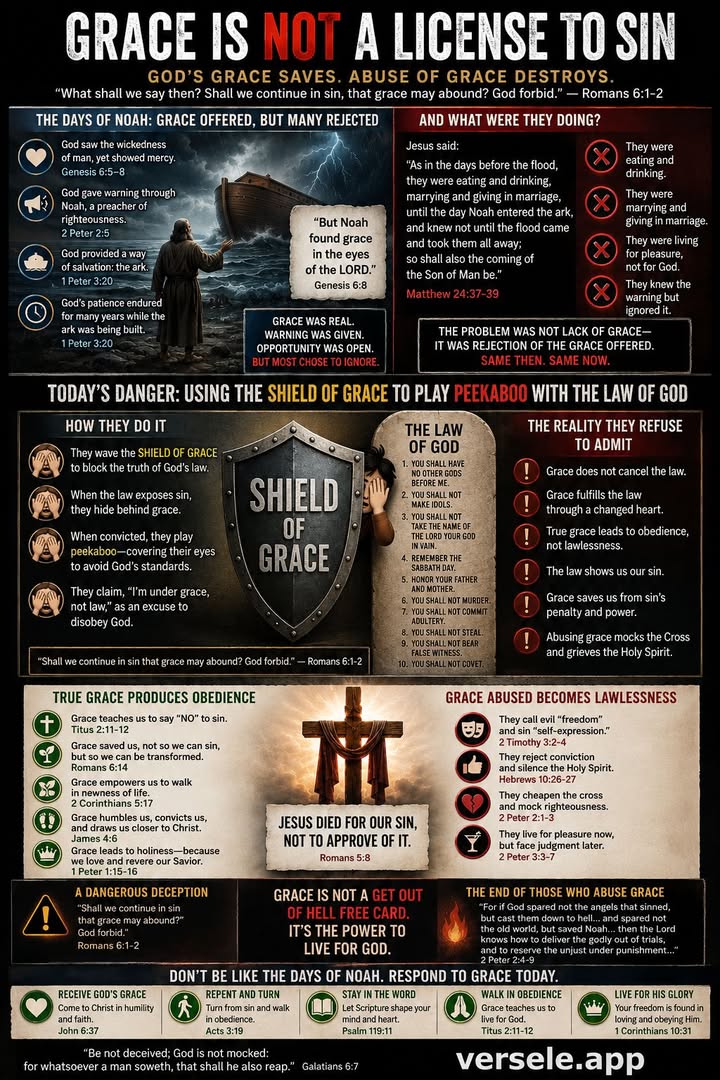
Many Christians today speak of grace as though it were God's permission slip to continue living in sin. Yet when we examine the Scriptures, we find that grace has never functioned that way.
The first mention of grace in the Bible appears in the days of Noah:
"But Noah found grace in the eyes of the LORD." (Genesis 6:8)
Notice what was happening at that time. The world was filled with violence, corruption, and wickedness. God saw the condition of mankind, yet He extended grace. He warned humanity through Noah. He provided an ark. He delayed judgment while the ark was being built.
Grace was present.
The question is: What did mankind do with that grace?
Jesus answers:
"For as in the days that were before the flood they were eating and drinking, marrying and giving in marriage, until the day that Noah entered into the ark, And knew not until the flood came, and took them all away..." (Matthew 24:38-39)
Their problem was not that grace was absent.
Their problem was that they ignored the grace that was offered.
They continued living as though God's warnings did not matter.
They continued pursuing their own desires.
They continued disregarding the commandments of God.
Grace was available.
Repentance was available.
Salvation was available.
Yet they chose rebellion.
The Same Spirit Exists Today
Many modern Christians have adopted a dangerous doctrine. They hold up what can only be described as a "Shield of Grace" and attempt to play peekaboo with the Law of God.
When Scripture exposes sin, they hide behind grace.
When God's commandments are mentioned, they hide behind grace.
When conviction comes, they hide behind grace.
When obedience is discussed, they hide behind grace.
They wave the shield and say:
"I'm under grace, not law."
Yet the question remains:
Under grace for what?
Grace was never given so that we could continue in sin.
Grace was given because we have sinned.
The purpose of grace is not to protect sin.
The purpose of grace is to rescue sinners.
What Does Grace Actually Teach?
The Bible says:
"For the grace of God that bringeth salvation hath appeared to all men, Teaching us that, denying ungodliness and worldly lusts, we should live soberly, righteously, and godly..." (Titus 2:11-12)
Grace teaches us to deny ungodliness.
Grace teaches us to turn away from sin.
Grace teaches us to live godly lives.
Notice what the passage does not say.
It does not say grace teaches us to ignore God's commandments.
It does not say grace teaches us to redefine sin.
It does not say grace teaches us that obedience no longer matters.
True grace always leads toward holiness.
What Is Sin?
The Apostle John gives a straightforward definition:
"Sin is the transgression of the law." (1 John 3:4)
If there is no law, there can be no transgression.
If the law is irrelevant, then sin becomes impossible to define.
Yet Scripture repeatedly defines sin by God's standards.
This is why the Law of God remains important.
The law does not save us.
The law identifies sin.
The law reveals our need for grace.
The law points us toward Christ.
The law is not the enemy.
Sin is the enemy.
Paul Never Taught Lawlessness
Many quote Paul as though he taught that obedience no longer matters.
Yet Paul himself asked:
"What shall we say then? Shall we continue in sin, that grace may abound? God forbid." (Romans 6:1-2)
Could Paul have been any clearer?
The very idea that grace permits ongoing rebellion caused Paul to respond with the strongest rejection possible:
"God forbid."
Paul did not teach lawlessness.
Paul taught freedom from the penalty of sin.
Paul taught freedom from condemnation.
Paul taught freedom from trying to earn salvation.
But he never taught freedom to disobey God.
Jesus Did Not Die To Approve Sin
The cross is often presented as though God lowered His standards.
The opposite is true.
The cross demonstrates how serious sin really is.
If sin were insignificant, Christ would not have needed to die.
Jesus did not die so that sin could be excused.
Jesus died so that sinners could be redeemed.
He died to transform us.
He died to reconcile us to God.
He died to create a people zealous for good works.
Noah's Generation and Our Generation
The days of Noah provide a sobering warning.
Grace was offered.
Warning was given.
A way of escape was provided.
Yet most people continued living as they pleased.
Eventually judgment came.
Jesus said the last days would be similar.
The issue will not be a lack of grace.
The issue will be what people choose to do with the grace they have received.
Will we respond with repentance?
Or will we use grace as a shield while continuing to ignore God's commands?
A Final Challenge
Do not use grace to play peekaboo with the Law of God.
Do not use grace to excuse what God calls sin.
Do not use grace to silence conviction.
Do not use grace to justify disobedience.
Instead, receive grace for what it truly is:
The unmerited favor of God that forgives sinners, transforms hearts, and leads believers into obedience.
Grace is not a license to sin.
Grace is God's power to live for Him.
The generation of Noah ignored that truth.
Let us not repeat their mistake.
versele.app.