The Chronology Of Passion Week: Counting The Days
Listen to this article4 min · read aloud
The Passover meal and the Last Supper were the same event. Don’t just take my word for it—look at John 13:1-2 (KJV): "Now before the feast of the Passover, when Jesus knew that his hour was come that he should depart out of this world unto the Father... And supper being ended, the devil having now put into the heart of Judas Iscariot, Simon’s son, to betray him."
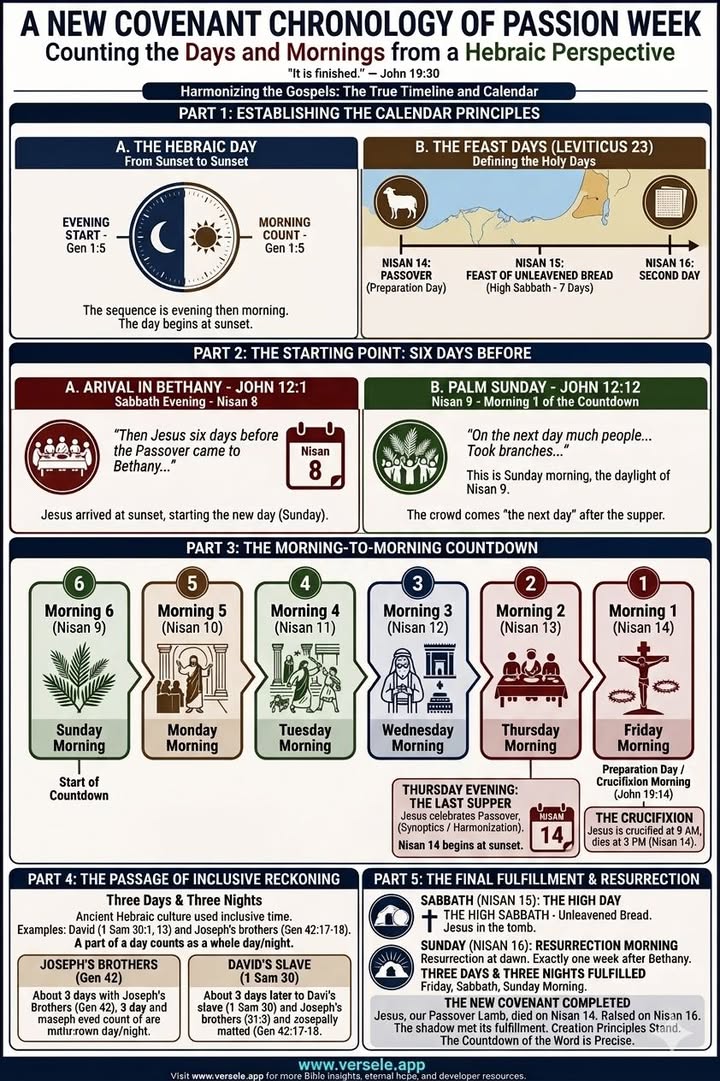
To understand this timeline, we must remember how God established the calendar. According to Leviticus 23:5-6, the Lord’s Passover begins at twilight on the 14th day of the first month (Nisan). On the very next day, the 15th of Nisan, the seven-day Festival of Unleavened Bread begins. In Jewish tradition, days begin at sunset, running from evening to morning (Genesis 1:5).
To find the exact timeline, there is only one starting verse you need to master. Look at John 12:1 (KJV): "Then Jesus, six days before the Passover, came to Bethany, where Lazarus was, which had been dead, whom he raised from the dead."
Jesus arrived in Bethany on Saturday evening. In the Jewish calendar, the sunset had already turned Saturday night into the first day of the week (Sunday). There, they made Him a supper. John 12:12 confirms this timing: "On the next day much people that were come to the feast, when they heard that Jesus was coming to Jerusalem, took branches of palm trees, and went forth to meet him..." This "next day" was Palm Sunday morning.
Ancient Jews tracked time by counting the daylight periods—the mornings. If we count the mornings from Palm Sunday down to the High Feast, the timeline becomes perfectly precise.
Let's use our fingers to count the mornings before the Feast:
• Morning 6 is Sunday morning (Palm Sunday).
• Morning 5 is Monday morning.
• Morning 4 is Tuesday morning.
• Morning 3 is Wednesday morning.
• Morning 2 is Thursday morning. (That evening, as the calendar flipped to Friday, Jesus celebrated the Passover meal/Last Supper and was betrayed).
• Morning 1 is Friday morning.
This makes Friday morning exactly one morning before—and the day before—the High Feast of Unleavened Bread. Friday daytime was the Day of Preparation. As John 19:14 states: "It was the day of Preparation for the Passover, about the sixth hour."
The Gospels clearly align on the day of the crucifixion. Luke 23:54 and Mark 15:42 both state that Jesus was crucified on Friday, the day of Preparation, just as the Sabbath was about to begin. John 19:31 notes that this upcoming Sabbath was a "high day" because the weekly Sabbath coincided perfectly with the annual first day of the Feast of Unleavened Bread (Nisan 15).
Our Lord was crucified on Friday morning at the third hour (9 AM), died at the ninth hour (3 PM), and was hastily buried before sunset. He rested in the tomb during the High Sabbath, and at early dawn on the first day of the week (Sunday morning), He rose from the dead, leaving an empty tomb exactly one week after being with Lazarus.
The Bible also shows us that ancient culture used inclusive time reckoning, where parts of a day were rounded to a full day. We see this in Genesis 42:17-18 when Joseph imprisoned his brothers for three days but released them "on the third day." We see it again in 1 Samuel 30:1-13 when David pursued the Amalekites "three days later," counting by the mornings. Therefore, spanning from Friday afternoon, through the Sabbath, to Sunday morning, it is entirely biblical and correct to say He was in the grave for three days and three nights.