The Man Of Sin: Has He Already Been Revealed?
Listen to this article21 min · read aloud
## Daniel, Jesus, and Paul — Following the Prophecy Through Scripture
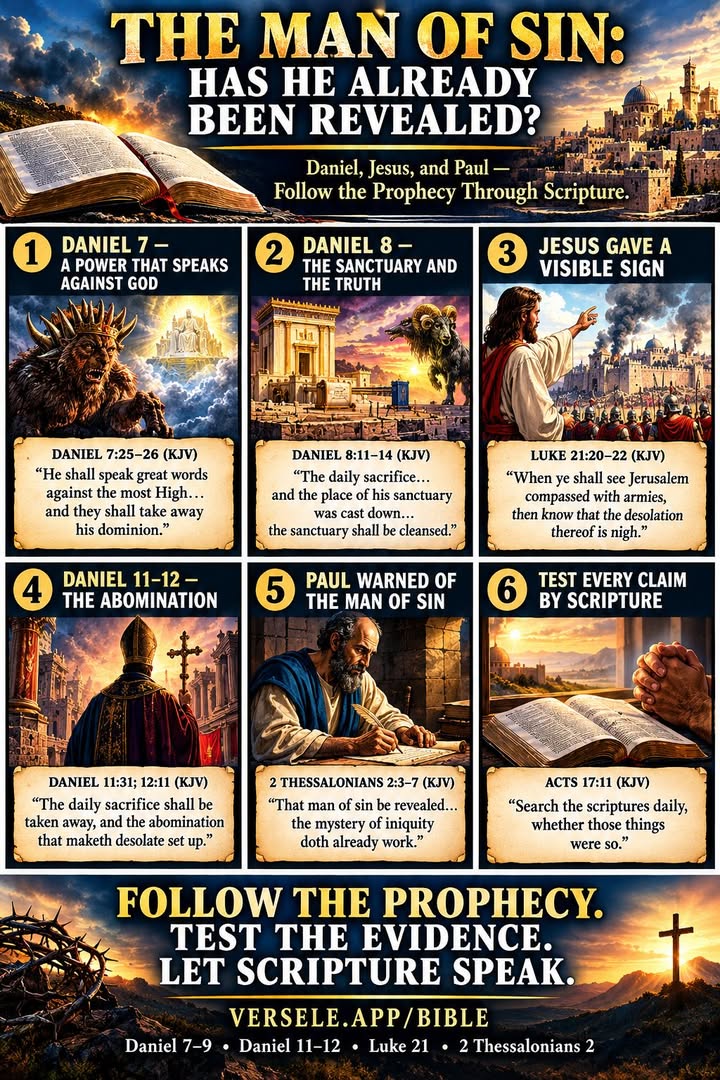
Are we waiting for the man of sin to appear in the future, or does the Bible reveal a power that was already at work in Paul's day, developed through history, and will continue until Jesus Christ brings it to an end?
Let us put aside human traditions, denominational assumptions, and the opinions of popular preachers. Let us open the Bible and allow Scripture to explain Scripture.
Our purpose is not to force a conclusion upon the reader. It is to examine what Daniel, Jesus, and Paul actually wrote, follow the connections between their words, and determine where the evidence leads.
1. DANIEL SAW A POWER THAT WOULD OPPOSE GOD
We begin with Daniel, because Paul did not introduce the subject of an opposing power without a prophetic background.
Daniel 7:25–26 (KJV)
“And he shall speak great words against the most High, and shall wear out the saints of the most High, and think to change times and laws: and they shall be given into his hand until a time and times and the dividing of time.
But the judgment shall sit, and they shall take away his dominion, to consume and to destroy it unto the end.”
Notice the characteristics.
👉 This power speaks against the Most High.
👉 It persecutes God's people.
👉 It presumes to change times and laws.
👉 It exercises dominion for a prophetic period.
👉 Finally, the heavenly judgment removes its dominion.
Daniel is not describing a power that disappears through an ordinary human overthrow. The decisive event is the judgment of God.
Now consider Daniel's second vision.
Daniel 8:25 (KJV)
“And through his policy also he shall cause craft to prosper in his hand; and he shall magnify himself in his heart, and by peace shall destroy many: he shall also stand up against the Prince of princes; but he shall be broken without hand.”
Again, the power magnifies itself and stands against the Prince of princes. Yet its end comes when it is broken “without hand.”
Daniel 7 and Daniel 8 therefore give us characteristics to investigate: self-exaltation, opposition to God, persecution, and a final overthrow that is not accomplished by human power.
But we must go further. Who is the Prince of princes? What sanctuary is involved? And how does the prophecy connect with the historical events surrounding Jerusalem?
We must allow the other passages to help answer these questions.
2. DANIEL 8 CONNECTS THE CONFLICT WITH THE SANCTUARY AND THE TRUTH
Daniel 8:11–12 (KJV)
“Yea, he magnified himself even to the prince of the host, and by him the daily sacrifice was taken away, and the place of his sanctuary was cast down.
And an host was given him against the daily sacrifice by reason of transgression, and it cast down the truth to the ground; and it practised, and prospered.”
Notice that the conflict is not merely political. Daniel describes an attack involving the sanctuary, the daily sacrifice, and the truth.
The vision then raises the question of how long the sanctuary-related desolation will continue.
Daniel 8:13–14 (KJV)
“Then I heard one saint speaking, and another saint said unto that certain saint which spake, How long shall be the vision concerning the daily sacrifice, and the transgression of desolation, to give both the sanctuary and the host to be trodden under foot?
And he said unto me, Unto two thousand and three hundred days; then shall the sanctuary be cleansed.”
This gives us another part of the picture. Daniel sees an attack upon what belongs to God, but he also sees that God has appointed an end to the period described.
We must not assume that every detail of this vision refers to exactly the same event or date. We must compare the symbols, the historical setting, and the explanations supplied within Daniel itself.
3. DANIEL 9 POINTS US TO JERUSALEM AND THE DESTRUCTION OF THE SANCTUARY
Daniel 9 begins with Daniel praying about Jerusalem's desolation and seeking understanding from the prophecies given through Jeremiah.
Daniel 9:2 (KJV)
“In the first year of his reign I Daniel understood by books the number of the years, whereof the word of the LORD came to Jeremiah the prophet, that he would accomplish seventy years in the desolations of Jerusalem.”
Later, Daniel receives the prophecy concerning the Messiah and the destruction of the city and sanctuary.
Daniel 9:26 (KJV)
“And after threescore and two weeks shall Messiah be cut off, but not for himself: and the people of the prince that shall come shall destroy the city and the sanctuary; and the end thereof shall be with a flood, and unto the end of the war desolations are determined.”
The passage speaks of two significant matters: the Messiah being cut off and the destruction of the city and sanctuary.
Which city and sanctuary are central to this chapter? Jerusalem and its sanctuary.
The Roman destruction of Jerusalem and the Second Temple in AD 70 is the historical event commonly connected with this prophecy and Jesus' subsequent warning about Jerusalem's desolation.
But here we must distinguish between two questions. What happened to Jerusalem and its sanctuary? And what does Daniel reveal about the power that opposes God and ultimately faces His judgment?
The first question concerns a historical destruction. The second requires us to follow the wider prophetic picture.
4. JESUS IDENTIFIED THE VISIBLE SIGN OF JERUSALEM'S COMING DESOLATION
Jesus did not leave His disciples without a warning.
Luke 21:20–22 (KJV)
“And when ye shall see Jerusalem compassed with armies, then know that the desolation thereof is nigh.
Then let them which are in Judaea flee to the mountains; and let them which are in the midst of it depart out; and let not them that are in the countries enter thereinto.
For these be the days of vengeance, that all things which are written may be fulfilled.”
Notice the clarity of Jesus' words.
👉 The sign: Jerusalem surrounded by armies.
👉 The warning: its desolation is near.
👉 The instruction: those in Judea must flee.
Jesus connects the warning with an identifiable historical crisis involving Jerusalem.
Now compare this with Daniel 9:26, which speaks of the city and sanctuary being destroyed. Jesus' words give His disciples a visible sign concerning the approaching desolation of Jerusalem.
Historically, Jerusalem and its temple were destroyed by Roman forces in AD 70.
That event is in the past. We should not pretend that the destruction of the Second Temple is still awaiting its first fulfillment.
But does the completion of that historical event mean that every power described in Daniel and Paul also came to an end in AD 70? We must examine the texts before drawing that conclusion.
5. DANIEL 11 AND 12 RETURN TO THE SANCTUARY, THE DAILY, AND THE ABOMINATION
Daniel 11:31 (KJV)
“And arms shall stand on his part, and they shall pollute the sanctuary of strength, and shall take away the daily sacrifice, and they shall place the abomination that maketh desolate.”
Daniel 12:11 (KJV)
“And from the time that the daily sacrifice shall be taken away, and the abomination that maketh desolate set up, there shall be a thousand two hundred and ninety days.”
Look at the repeated language.
The sanctuary is polluted. The daily sacrifice is taken away. The abomination that makes desolate is set up.
These recurring themes require us to study Daniel 8, 9, 11, and 12 together rather than treating each chapter as an entirely unrelated prophecy.
Daniel 8 describes the sanctuary being cast down and the truth being thrown to the ground. Daniel 9 speaks of the destruction of Jerusalem and the sanctuary. Daniel 11 describes the sanctuary being polluted and the abomination being established. Daniel 12 again refers to the removal of the daily and the abomination that makes desolate.
The precise relationship between the events and periods must be established by careful examination of the text. Repeated wording is important evidence, but it does not give us permission to skip the work of interpretation.
The essential question remains: how does this prophetic picture connect with the power Paul describes in 2 Thessalonians 2?
6. PAUL DESCRIBED THE MAN OF SIN — BUT HE ALSO SAID THE MYSTERY WAS ALREADY AT WORK
Now we arrive at the passage that prompted this study.
2 Thessalonians 2:3–4 (KJV)
“Let no man deceive you by any means: for that day shall not come, except there come a falling away first, and that man of sin be revealed, the son of perdition;
Who opposeth and exalteth himself above all that is called God, or that is worshipped; so that he as God sitteth in the temple of God, shewing himself that he is God.”
Paul describes a figure or power that opposes God and exalts itself above everything called God or worshipped. The language is extraordinary.
Now notice what Paul says about the timing.
2 Thessalonians 2:5 (KJV)
“Remember ye not, that, when I was yet with you, I told you these things?”
Paul had already taught the Thessalonians about this subject. He expected them to remember what he had told them.
Then he writes:
2 Thessalonians 2:6–7 (KJV)
“And now ye know what withholdeth that he might be revealed in his time.
For the mystery of iniquity doth already work: only he who now letteth will let, until he be taken out of the way.”
This is a crucial distinction.
Paul says the mystery of iniquity was already at work in his day. Therefore, the activity of lawlessness was not something that would begin only in a distant future.
At the same time, Paul speaks of a restraining force and a revealing that would occur in its appointed time. He does not explicitly identify the restrainer in these verses, so we must be careful not to claim more than the text says.
Here is the question we must investigate: could the lawlessness already operating in Paul's day develop into the historical power described by Daniel, with its identity and activities becoming clearer as the prophetic story unfolds?
That is the connection we must test through Scripture and history.
Paul knew the prophetic Scriptures. His description of the man of sin should therefore be studied alongside Daniel's descriptions of the power that exalts itself against God.
7. PAUL'S WORDS MUST BE READ ALONGSIDE DANIEL'S PROPHECIES
Compare the passages.
Daniel 7:25 describes a power that speaks great words against the Most High and persecutes the saints.
Daniel 8:25 describes a power that magnifies itself and stands against the Prince of princes.
Second Thessalonians 2:3–4 describes the man of sin, who opposes and exalts himself above all that is called God or worshipped.
These similarities are significant. They provide a biblical basis for examining whether Paul is describing the same prophetic power or a closely related manifestation of the opposition Daniel saw.
But we must also respect the differences between the passages. Daniel does not explicitly use Paul's expression “man of sin,” and Paul does not directly name Daniel's little horn in 2 Thessalonians 2.
The identification must therefore be demonstrated by comparing the characteristics, the prophetic sequence, and the historical evidence rather than simply assuming that the names are interchangeable.
The interpretation I am examining is that the man of sin represents an enduring religious power associated with papal Rome, rather than only an individual who appears briefly at the end of the world.
This conclusion must be tested against the Bible's descriptions of self-exaltation, religious authority, persecution, opposition to truth, and final divine judgment.
It must not rest merely on a label or on what any preacher claims.
8. IS THIS POWER STILL TO BE REVEALED, OR HAS IT ALREADY EMERGED IN HISTORY?
Paul's statement that the mystery of iniquity was already at work is important. It means that the roots of the lawlessness he describes were present in the apostolic age.
Paul also speaks of a later revealing. The text does not tell us that every detail of the power's historical development had already occurred while he was alive.
We, living many centuries after Paul and after the destruction of Jerusalem in AD 70, can examine the subsequent history and ask whether a religious institution fits the characteristics described in Daniel and Paul.
The position being proposed here is that the man of sin has been revealed through the historical development of papal Rome and that this power's prophetic story continues until Christ brings it to an end.
That is a historical interpretation of the biblical evidence, not a sentence that appears verbatim in one verse. It must be assessed by comparing Scripture with Scripture and by examining whether the historical claims genuinely fit the characteristics.
This distinction matters. We should never tell people that the Bible explicitly names a modern institution in a passage where it does not do so. Instead, we should show the evidence and explain why we believe the identification fits.
Nor should we confuse criticism of an institution's claims with a judgment upon every Catholic individual. Our concern is whether any religious authority claims what belongs to God and whether those claims agree with the teaching of Jesus Christ.
The question is not whether people have good intentions. The question is whether the doctrine and authority being examined stand up to the Word of God.
9. HOW DOES THE MAN OF SIN FINALLY END?
Paul answers this question directly.
2 Thessalonians 2:8 (KJV)
“And then shall that Wicked be revealed, whom the Lord shall consume with the spirit of his mouth, and shall destroy with the brightness of his coming.”
Now compare this with Daniel 8:25:
“He shall also stand up against the Prince of princes; but he shall be broken without hand.”
And remember Daniel 7:26:
“But the judgment shall sit, and they shall take away his dominion, to consume and to destroy it unto the end.”
The connection is clear in its central point: the power opposing God does not prevail forever. Its dominion ends through God's judgment and intervention.
Daniel does not say that ordinary human beings will finally overthrow this power by their own strength. Paul does not say that the Lord's final victory depends upon the power's opponents being strong enough to destroy it themselves.
The final authority belongs to God.
Our responsibility is to proclaim the truth, remain faithful to Jesus Christ, and warn people against deception. God's responsibility as Judge is not ours to usurp.
10. WILL EVERYONE BE DECEIVED?
Paul does not teach that every human being must necessarily choose evil.
Second Thessalonians 2:9–12 warns about deception, lying wonders, rejection of the truth, and the consequences of taking pleasure in unrighteousness.
Verse 10 identifies a central problem:
“Because they received not the love of the truth, that they might be saved.”
The issue is not merely that people lack information. Paul warns about refusing to love and receive the truth.
That is why this study must not become an exercise in attacking people. We must examine ourselves, test what we believe, and be willing to correct our understanding when the Scriptures require it.
A person should not accept a claim merely because a religious leader makes it. Neither should a person reject a claim simply because it challenges a familiar tradition.
The Scriptures must be examined.
Acts 17:11 (KJV)
“These were more noble than those in Thessalonica, in that they received the word with all readiness of mind, and searched the scriptures daily, whether those things were so.”
That is the standard we should follow.
CONCLUSION: LET US FOLLOW THE EVIDENCE WHEREVER SCRIPTURE LEADS
Daniel describes a power that exalts itself against God, persecutes the saints, and ultimately loses its dominion when divine judgment takes place.
Daniel 8 adds the conflict over the sanctuary and the truth. Daniel 9 describes the destruction of Jerusalem and its sanctuary. Daniel 11 and 12 return to the sanctuary, the daily sacrifice, and the abomination that makes desolate.
Jesus gives His disciples a visible warning concerning Jerusalem surrounded by armies, and the city's destruction in AD 70 provides the historical setting for that warning.
Paul, writing before that destruction, describes the man of sin and tells his readers that the mystery of iniquity was already at work in his day. He also declares that the wicked one will ultimately be destroyed by the Lord Jesus Christ.
The interpretation presented here is that these passages contribute to one prophetic picture of opposition to God, an opposition already active in Paul's time that develops through history and ends only when Christ brings it to judgment.
That conclusion must be examined carefully. We should distinguish the words of Scripture from our interpretation of those words, and we should never conceal a difficult question merely to protect a preferred conclusion.
But neither should we ignore the connections Scripture itself invites us to investigate.
Our faith is not built upon the reputation of a preacher, the authority of a denomination, or the popularity of a religious tradition.
It is built upon Jesus Christ and the truth of God's Word.
So I invite you to do what the Bereans did: open your Bible, read these passages in context, compare them, and examine the evidence.
If my interpretation is wrong, let Scripture correct me. If the evidence supports the conclusion, let Scripture establish it.
The final word does not belong to the man of sin.
It belongs to the Lord Jesus Christ.
Open the Bible. Examine the evidence. Follow the truth.