When Tradition Overrules The Word Of God.
Listen to this article13 min · read aloud
Let that sink in for a moment.
I love the people of God. I love fellowship. I love gathering with believers. But my loyalty to God must always come before my loyalty to any religious institution, denomination, tradition, or popular interpretation.
The question is not whether a teaching is popular, traditional, or accepted by the majority. The question is: WHERE IS IT WRITTEN IN THE WORD OF GOD?
This is not an attack on people. It is a call back to Scripture.
Yeshua (Jesus) confronted religious leaders who had allowed human traditions to take the place of God's commandments.
Mark 7:7–9 KJV
“Howbeit in vain do they worship me, teaching for doctrines the commandments of men.
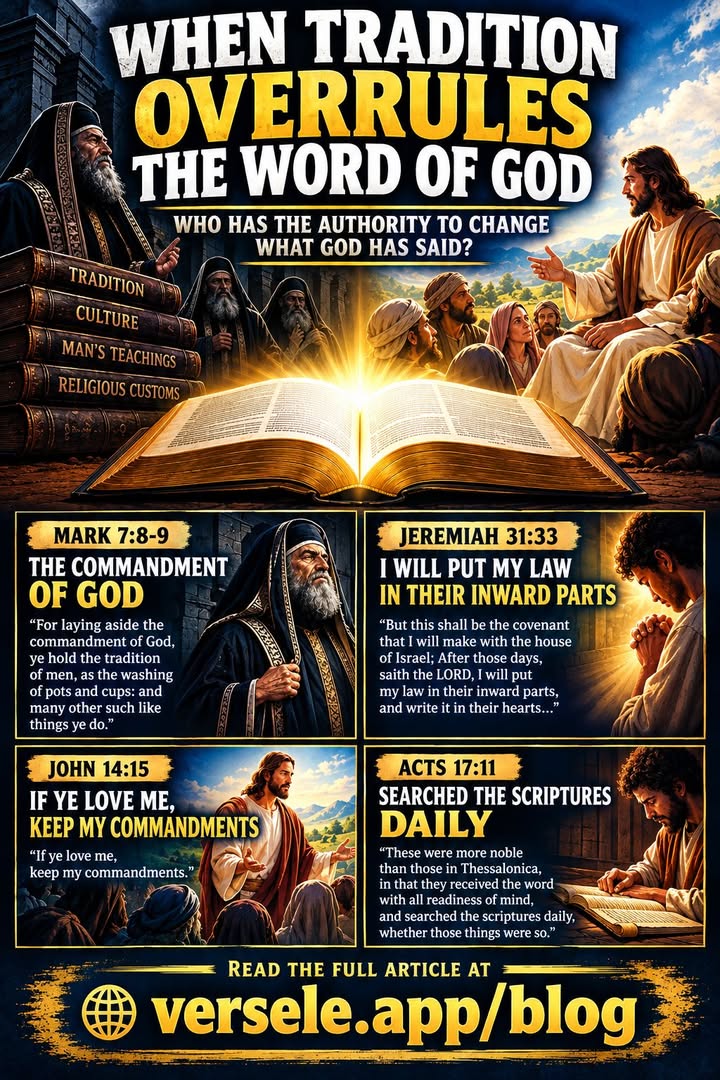
For laying aside the commandment of God, ye hold the tradition of men, as the washing of pots and cups: and many other such like things ye do.
And he said unto them, Full well ye reject the commandment of God, that ye may keep your own tradition.”
👉 Read those words again.
Jesus did not praise religious tradition simply because it was old, popular, or sincerely practiced. He exposed the danger of allowing human teachings to displace the commandments of God.
If Jesus confronted this problem in His own day, why would we assume it could never happen in Christianity today?
The issue is not whether people are sincere. People can be sincere and still be mistaken. The issue is whether our beliefs agree with the written Word of God.
THE MYSTERY OF LAWLESSNESS DID NOT BEGIN IN OUR GENERATION.
Paul wrote:
2 Thessalonians 2:7 KJV
“For the mystery of iniquity doth already work: only he who now letteth will let, until he be taken out of the way.”
And John wrote:
1 John 2:3–4 KJV
“And hereby we do know that we know him, if we keep his commandments.
He that saith, I know him, and keepeth not his commandments, is a liar, and the truth is not in him.”
Notice what Scripture says.
The mystery of lawlessness was already at work in the apostles' time. John warned that claiming to know God while refusing His commandments contradicts that claim.
This is why we must examine the teachings we have inherited. Religious error does not have to arrive openly declaring war against God. It can enter gradually, become familiar, acquire religious acceptance, and eventually be defended as though God Himself commanded it.
A practice being old does not make it biblical. A tradition being widespread does not make it God's command. And repeating a teaching for centuries does not transform it into Scripture.
THE REAL QUESTION IS: WHO GAVE US THE AUTHORITY TO CHANGE WHAT GOD HAS SAID?
Consider the words of Paul:
1 Corinthians 10:20–21 KJV
“But I say, that the things which the Gentiles sacrifice, they sacrifice to devils, and not to God: and I would not that ye should have fellowship with devils.
Ye cannot drink the cup of the Lord, and the cup of devils: ye cannot be partakers of the Lord's table, and of the table of devils.”
Paul was addressing actual participation in idolatrous worship. His warning establishes a principle we cannot ignore: worship of God must not be mixed with idolatry.
And Scripture asks:
2 Corinthians 6:14 KJV
“For what fellowship hath righteousness with unrighteousness? and what communion hath light with darkness?”
We must therefore test religious practices by the Word of God, not merely by their popularity, emotional appeal, or cultural acceptance.
The question is not whether a tradition makes us feel closer to God. The question is whether God has authorized it.
BUT HERE IS WHERE THE DISCUSSION BECOMES EVEN MORE IMPORTANT: WHAT ABOUT GOD'S COMMANDMENTS?
Many Christians are taught that God's law no longer matters, that obedience belongs to another age, or that the commandments have somehow become irrelevant under the New Covenant.
But does that teaching agree with what God promised through His prophets?
Jeremiah 31:31, 33 KJV
“Behold, the days come, saith the LORD, that I will make a new covenant with the house of Israel, and with the house of Judah:”
“But this shall be the covenant that I will make with the house of Israel; After those days, saith the LORD, I will put my law in their inward parts, and write it in their hearts; and will be their God, and they shall be my people.”
Pay attention to what God promised.
He did not say that under the New Covenant He would write lawlessness into our hearts. He promised to put His law within His people.
The question, then, is not whether we need a new covenant. God promised one. The question is: WHAT DOES GOD SAY HE WOULD DO WITH HIS LAW UNDER THAT COVENANT?
He promised to write it in the heart.
Now listen to Jesus:
John 14:15 KJV
“If ye love me, keep my commandments.”
And again:
Matthew 5:17–19 KJV
“Think not that I am come to destroy the law, or the prophets: I am not come to destroy, but to fulfil.
For verily I say unto you, Till heaven and earth pass, one jot or one tittle shall in no wise pass from the law, till all be fulfilled.
Whosoever therefore shall break one of these least commandments, and shall teach men so, he shall be called the least in the kingdom of heaven: but whosoever shall do and teach them, the same shall be called great in the kingdom of heaven.”
We must allow Jesus' own words to shape our understanding of His mission. We cannot simply assume that fulfilling the law means abolishing everything God commanded. We must examine what He actually said and how the rest of Scripture explains it.
WHAT ABOUT THE SABBATH? DID GOD INCLUDE THE NATIONS IN HIS PROMISE?
Read Isaiah 56 for yourself.
Isaiah 56:2, 6–7 KJV
“Blessed is the man that doeth this, and the son of man that layeth hold on it; that keepeth the sabbath from polluting it, and keepeth his hand from doing any evil.”
“Also the sons of the stranger, that join themselves to the LORD, to serve him, and to love the name of the LORD, to be his servants, every one that keepeth the sabbath from polluting it, and taketh hold of my covenant;
Even them will I bring to my holy mountain, and make them joyful in my house of prayer: their burnt offerings and their sacrifices shall be accepted upon mine altar; for mine house shall be called an house of prayer for all people.”
Notice the people described in this prophecy.
God specifically mentions foreigners who join themselves to the LORD, serve Him, love His name, and keep His Sabbath. His house is to be a house of prayer for all people.
This passage deserves an honest examination. We should not dismiss it simply because it challenges what we have been taught.
And notice that the passage speaks of burnt offerings and sacrifices in the prophetic setting. We must read the passage in its historical and prophetic context rather than assuming every detail applies in exactly the same way under the New Covenant.
The point is clear: the inclusion of the nations in God's purposes does not give us permission to ignore what He says about obedience.
THE NEW COVENANT DOES NOT CALL US TO LAWLESSNESS. IT CALLS US TO A TRANSFORMED HEART.
Paul asks:
Romans 3:31 KJV
“Do we then make void the law through faith? God forbid: yea, we establish the law.”
And John gives us this sobering warning:
1 John 3:4 KJV
“Whosoever committeth sin transgresseth also the law: for sin is the transgression of the law.”
We must therefore distinguish between what Scripture actually says and what people claim it says.
Yes, we are saved by God's grace. Yes, we need faith in Jesus Christ. But grace must not be used as an excuse to dismiss God's commandments. We must allow the whole counsel of Scripture to explain the relationship between faith, grace, obedience, and the New Covenant.
CALLING PEOPLE BACK TO THE BIBLE IS NOT REBELLION AGAINST GOD'S PEOPLE. IT IS AN INVITATION FOR ALL OF US TO EXAMINE OURSELVES.
The Bereans were commended because they examined the Scriptures to determine whether what they heard was true.
Acts 17:11 KJV
“These were more noble than those in Thessalonica, in that they received the word with all readiness of mind, and searched the scriptures daily, whether those things were so.”
That is the standard we need today.
Do not believe something merely because I say it. Do not reject it merely because your pastor disagrees with it. Open the Bible. Read the entire passage. Compare Scripture with Scripture. Ask God for understanding. Be willing to change your mind when the Word exposes an error in your understanding.
And that applies to me just as much as it applies to you.
HERE IS THE CHALLENGE:
If a church teaches something, ask where Scripture teaches it.
If a tradition contradicts a commandment of God, ask why the tradition should take precedence.
If someone tells you that a commandment no longer matters, ask where the Bible says so and read the passage in context.
If someone claims that obedience is unnecessary, compare that claim with the words of Jesus and the apostles.
And if Scripture corrects any of us, let us have the humility to accept correction.
Truth is not determined by a majority vote.
God's Word is not made true by our agreement, nor made false by our disagreement.
I AM NOT ASKING YOU TO FOLLOW ME. I AM ASKING YOU TO TEST EVERYTHING BY THE WORD OF GOD.
My loyalty is not to a denomination. It is not to a church tradition. It is not to what my family has always believed or what the majority finds comfortable.
My loyalty must be to the God of the Bible and to Jesus Christ, the Messiah.
Because at the end of the day, the most important question is not:
“WHAT DOES MY CHURCH TEACH?”
The question is:
“WHAT HAS GOD SAID?”
Let the Scriptures answer.
Let the traditions be examined.
Let our hearts be corrected.
And let us worship God in spirit and in truth.
John 17:17 KJV
“Sanctify them through thy truth: thy word is truth.”